


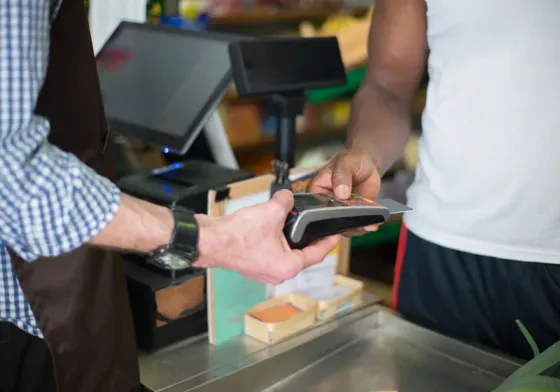














If you pay with a debit card from a big bank, a court just ruled that the cap on what your bank charges the store for each swipe is set too high. Retailers say that money comes back to you at the register.
Don’t hold your breath. The last time Washington cut debit fees, the stores kept the savings and the banks sent the bill to your checking account.
On October 26, the Eighth Circuit threw out the Federal Reserve’s debit swipe fee cap in Corner Post v. Board of Governors. The cap, built on a 21-cent base, has barely moved since 2011. The court said the Fed let banks count fixed costs they’d pay whether or not you swiped, and the law doesn’t allow that. Translation: the cap is too high, and the Fed has to redo the math.
The Retail Litigation Center, which backed the challenge, called it “a significant victory for every retailer and consumer forced to pay inflated debit-card fees.” Nice line. Here’s the record.
Two years after the 2011 cap took effect, the Richmond Fed surveyed 420 merchants. It estimated that 77.2% didn’t change prices, 21.6% raised them, and 1.2% cut them. That’s about one store in 83.
The banks did move. The Government Accountability Office, reviewing the research in 2022, found that large banks raised checking account fees to make up the lost swipe revenue.
So who pays for a lower cap? Run it on 30 debit swipes a month. In 2024 a covered bank earned an average of 23 cents a swipe, per Fed data. That’s $6.90 a month the bank collects on your spending. When the Fed proposed a lower cap in 2023, the cap on a $50 purchase would have dropped from 24.5 cents to 17.7 cents. A cut that size would cost your bank about $2 a month on your account, roughly $24 a year.
A $5 monthly maintenance fee gets back $60.
Bank’s bet: you won’t notice a new fee, and you’ll never see a price cut at the store either way. That’s how a price control plays out. The store and the bank swap a few cents, and your account holds the tab.
Here’s the part nobody’s leading with. The cap only covers banks that, with their affiliates, hold $10 billion or more. The Fed’s current list has 510 of those and 8,537 exempt issuers, 4,360 of them credit unions. Exempt issuers averaged 51 cents a swipe in 2024, more than twice what big banks got. The cap never applied to them, and whatever the Fed writes next won’t either.
What to do this week
Check your bank. The Fed publishes both lists on its small issuer exemption page. If your bank or credit union is on the exempt list, this ruling doesn’t touch it. You’re done.
If it’s covered, write down two numbers. Pull your account’s fee schedule and note the monthly fee and exactly what waives it: direct deposit size, minimum balance, or both. That’s your baseline. If a change-in-terms notice shows up next year, you’ll know in ten seconds whether you lost.
Keep a switch ready. If your free account picks up a fee, move it. Compare options on our savings page, and run what idle cash should be earning with the savings calculator.
Nothing changes at checkout for now. The ruling isn’t in effect yet and may face further review. A similar case, Linney’s Pizza, is pending in the Sixth Circuit, where the lower court upheld the Fed’s rule. Then the Fed has to write a new cap. File this away, and check your fee schedule when the new number lands.
How Candid Yak makes money. Some of the products we write about pay us if you apply or sign up through our links. That never changes our verdict, our rankings, or the numbers in this article. We call a bad deal a bad deal whether it pays us or not. Some brands shown in our comparison tools are placeholder examples while we finalize partner agreements, and we label them as such.
Sources
- Federal appeals court strikes down the Fed's debit card fee cap (ABA Banking Journal, October 2026)
- Retailers Applaud Eighth Circuit Decision Striking Down Fed's Debit Swipe Fee Cap (Retail Industry Leaders Association, October 2026)
- Federal Reserve Must Scrap 21-Cent Cap on Debit Card Swipe Fees, US Appeals Court Says (Law.com, October 27, 2026)
- Average Debit Card Interchange Fee by Payment Card Network, 2024 (Federal Reserve Board)
- Interchange Fee Standards: Small Issuer Exemption lists (Federal Reserve Board)
- Federal Reserve Board requests comment on proposal to lower the interchange fee cap (Federal Reserve Board, October 25, 2023)
- The Impact of the Durbin Amendment on Merchants: A Survey Study (Federal Reserve Bank of Richmond Economic Quarterly, 2014)
- Banking Services: Regulators Have Taken Actions to Increase Access (U.S. Government Accountability Office, GAO-22-104468, 2022)